Concrete contractor · Elgin, IL
Concrete Contractor for Elgin and the Fox Valley
Driveways, patios, stamped work, walks, slabs, walls, garage floors and repair, poured to what the City of Elgin actually asks for and explained before you sign anything.
Elgin, South Elgin, St. Charles, Bartlett, Carpentersville, Hoffman Estates, Streamwood, Algonquin and nearby Kane County.
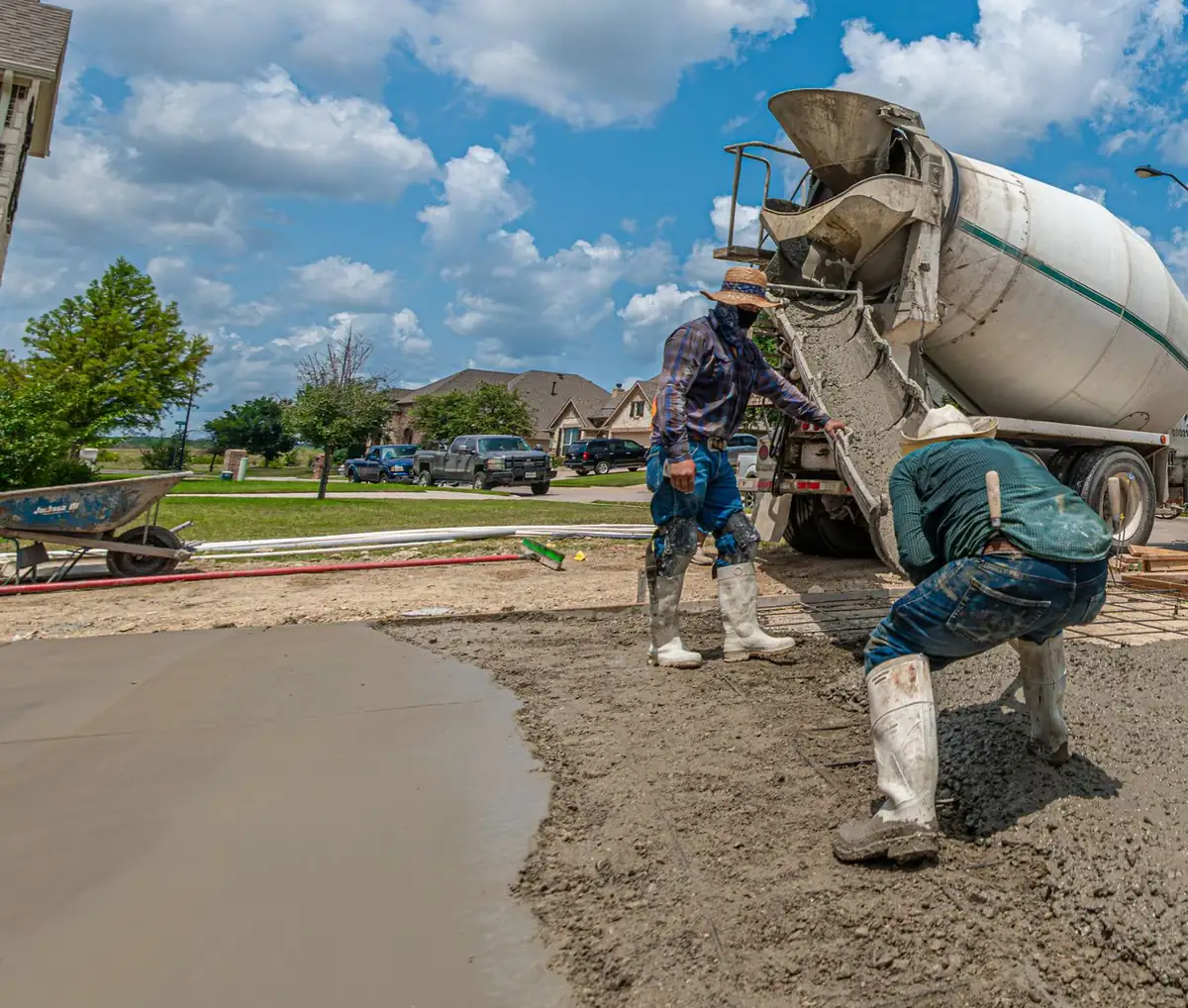
- 4000 psiair-entrained: the City of Elgin minimum for driveway concrete
- 4 + 4 in.compacted gravel under concrete on an Elgin driveway
- 42 in.footing depth the City asks for under stoops and garage walls
- 3–10 daysnotice JULIE needs before anyone digs
Concrete companies near me: what we pour around Elgin
Residential concrete services first, plus flatwork for businesses and HOAs. Each service has its own page with the specs, the City rules that apply and the decisions you’ll actually face. Poured concrete walls, concrete steps and porches, curbs and footings are covered inside the pages they belong to.
Driveways & walks
- Concrete Driveways Tear-out and replacement or a first pour, built to the City of Elgin driveway spec. Removal, base, 4000 psi air-entrained mix, apron coordination
- Sidewalks & Walkways Front walks, side paths and service walks, poured or replaced with proper pitch and joints. Walks, landings, trip-lip removal, replacement
Patios & decorative
- Concrete Patios Poured backyard patios and extensions, broom-finished or pressed, sized to how you use the yard. New patios, extensions, slab tear-out, sealing
- Stamped & Decorative Concrete Pattern-stamped patios, walks and borders, color-hardened and sealed, plus exposed aggregate. Stamp patterns, color, borders, exposed aggregate, resealing
- Concrete Resurfacing Overlays for slabs that are sound underneath but scaled, worn or dated on top. Microtopping, stampable and spray overlays
Slabs & floors
- Foundations & Slabs Footings, garage and shed slabs, pads and additions, set below the frost line where the code asks. Footings, garage slabs, pads, additions
- Garage Floor Epoxy Ground, repaired and coated garage floors that stand up to salt slush tracked in all winter. Grinding, crack repair, epoxy and polyaspartic systems
- Commercial Concrete Flatwork for businesses, HOAs and property managers: walks, pads, curbs and repairs. Flatwork, curbs, dumpster pads, ADA walks
Walls & repair
- Retaining Walls Poured concrete and segmental block walls with the drainage behind them done right. Poured walls, block walls, drainage, replacement
- Concrete Repair Steps, stoops, cracks and scaled surfaces: fixed when a fix will last, replaced when it won’t. Crack repair, step rebuilds, patching, partial replacement
- Concrete Leveling Sunken walks, patios and driveway panels lifted with foam or mudjacking instead of torn out. Polyurethane foam lifting, mudjacking, joint sealing
What does a concrete driveway in Elgin have to meet?
Elgin publishes its driveway rules as a one-page quick guide, and it is more specific than most homeowners expect. Exterior concrete must be at least 4000 psi and air-entrained. The slab sits on at least 4 inches of compacted gravel under 4 inches of concrete, 8 inches in total. You need a permit before work starts, a plat of survey with the new driveway drawn on, zoning approval, and a final inspection.
The part that catches people: the approach between your property line and the street, the public sidewalk and the curb need their own engineering permit. A driveway quote that stops at the property line and a quote that includes the apron are two different jobs.
The concrete driveway page goes through tear-out, base, joints, finishes and what replacement costs.
Broom-finished or pressed: which patio suits an Elgin backyard?
Both start the same way. Elgin’s patio guide calls for 3000 psi air-entrained concrete at least 4 inches thick, recommends wire mesh and a 4 inch gravel base, and offers an optional pre-pour inspection to confirm the patio’s location before concrete arrives. The difference is the top.
Broom-finished concrete
The lowest cost per square foot, the most grip on a wet or frosty morning, and nothing to reseal. It suits patios that are mostly for furniture and grilling. A concrete patio can still get a colored or smooth-troweled border.
Patterned and colored finishes
Pattern mats press slate, stone or wood-plank texture into the fresh surface, with a color hardener and a contrasting release. It costs more, and the sealer needs renewing to keep the color. Stamped and decorative concrete covers patterns, borders and upkeep.
Why does Elgin concrete crack, scale and sink?
Three local conditions do most of the damage. The ground: much of the Elgin area sits on glacial till that the Illinois State Geological Survey describes as silty clay, silty clay loam and clay, which holds water and settles under a slab when the base was thin or downspouts dump beside it. The cold: NOAA’s Elgin station averages 139 days a year with a low at or below freezing. The salt: City crews treat more than 380 lane miles with road salt and a brine of beet juice by-product and calcium chloride, and cars carry it onto aprons and garage floors.
Sources: ISGS Elgin quadrangle map (2007); NOAA 1991–2020 normals, Elgin station; City of Elgin Snow & Ice Control.
-
Cracked slabs and crumbling steps
Patching, crack repair and step rebuilds when the slab is otherwise sound; replacement when it isn’t.
-
Sunken walks, patios and driveway panels
Foam lifting or mudjacking raises a slab that dropped in one piece, for less than tearing it out.
-
Scaled but solid surfaces
An overlay renews a flaking top on a slab that still sits level. It won’t fix movement.
What paperwork does a concrete company handle on an Elgin job?
Most of a concrete job’s paperwork is set by the City’s quick guides and Illinois’ one-call law. Here is the stack for a typical driveway, patio or stoop. Who files each sheet, you or the contractor, is worth settling in writing before the start date.
-
The surveyed drawing of the lot with the new driveway, patio or walk drawn on, showing locations, dimensions and setbacks. Elgin’s driveway, patio and sidewalk quick guides all ask for it. No plat in the drawer? Ordering one adds time, so look early.
-
Driveways, patios and sheds go through planner review, which the City estimates at about 7 to 10 business days. “No work can begin prior to a permit being issued,” and every project is subject to zoning approval.
Source: City of Elgin Permits
-
The approach between your property line and the street, the public sidewalk and the curb are City right-of-way. Elgin requires separate engineering permits for that work, on top of the driveway or sidewalk permit.
Source: City of Elgin Permits
-
State law requires notice to JULIE at least 3 but not more than 10 days before digging, weekends and holidays not counted. Utilities mark only their own lines; sprinkler lines, private sewer laterals and other owner lines are yours to find.
Source: JULIE: when to call
-
Needed for exterior work on a landmark or in one of the City’s historic districts, such as the Elgin Historic District or the Spring/Douglas district. Each concrete quick guide repeats the rule.
Source: City of Elgin Historic Districts
-
The City’s guides warn that many subdivisions have private covenants that supersede City zoning, and that the City doesn’t enforce them. Check with the homeowners association before work starts.
-
Stoops and stairs need a pier inspection of the footing holes before concrete goes in. Patios and retaining walls can get an optional pre-pour inspection. Driveways, patios, walks, stoops and walls all need a final inspection.
Source: City of Elgin Quick Guides
Click a sheet to read it. Bigger jobs add more: a retaining wall needs plans sealed by a structural engineer.
Where it gets heavier
Retaining walls: Elgin’s guide asks for plans signed and sealed by a structural engineer, with soil data and drainage, for any permitted wall.
Foundations and slabs: footings at least 42 inches below grade for garage walls, or a grade-beam slab for detached garages of 490 sq ft or less.
Sidewalks and walkways: private walks stay inside the property line; anything in the right-of-way needs separate permits, fees, bonds and inspections.
How much do concrete contractors charge in Elgin?
We don’t publish prices that haven’t seen your site. Here is what a national lead service publishes for the Elgin area, so you can sanity-check a bid, then what moves a real number up or down.
-
HomeAdvisor’s Elgin page for concrete driveways and floors. The same $5,196 average shows up on its pages for other suburbs, so read it as a regional figure, not Elgin data. Source: HomeAdvisor, Elgin concrete flatwork
-
From HomeAdvisor’s Elgin patio page, which is a paver category; poured concrete patios aren’t broken out separately. Source: HomeAdvisor, Elgin patios
-
Listed as a related project on the same HomeAdvisor Elgin page, with no low, high or average given. Source: HomeAdvisor, Elgin related projects
Thin line: reported low to high. Thick band: typical range. Tick: average. Published third-party estimates for the Elgin area, not our prices; your written estimate depends on your site.
What moves a concrete price up or down
- Tear-out and haul-away of the old slab, and whether a skid steer can reach it.
- Base work: how much soft soil comes out and how much stone goes in.
- Thickness, strength and reinforcement beyond the City minimums.
- Finish: broom is the baseline; exposed aggregate and stamped cost more.
- The apron: right-of-way work adds an engineering permit.
- Season: cold-weather protection adds blankets, heated water or accelerators.
Cost sections on each page go further, for example driveway replacement and garage floor epoxy.
Cement contractors near me: how a job runs from first call to walkthrough
The questions homeowners actually ask along the way, in the order they come up. Tap a question to read the answer, or walk through the whole conversation.
-
First call
-
Site visit
Elite Concrete ElginSlope and where water goes, how the slab meets the garage and the street, what’s under it if a corner is broken, downspouts, trees, and access for a truck. If part of the work is the approach or public walk, that adds the City’s engineering permit to the plan.
-
Estimate
Elite Concrete ElginCompare the lines, not the totals: tear-out and haul-away, base depth, concrete thickness and strength, reinforcement, joints, finish, permits and the apron. A low bid that’s silent on base or mix is usually the reason it’s low. Older houses can hide surprises under the old slab, so keep some reserve in your budget.
-
Before work
Elite Concrete ElginSettle it in writing before the start date. Either way, Elgin wants the permit issued before work begins, and JULIE needs 3 to 10 days’ notice before digging. Historic district and HOA approvals come first if they apply.
-
Prep days
Elite Concrete ElginBase and forms are the part you don’t see later: grading, compacting the gravel, setting pitch so water runs away from the house, and any inspection the job needs (stoop footings get a pier inspection before concrete). Rushing this is how slabs end up sinking.
-
Pour day
Elite Concrete ElginWalking comes first, cars later, and the timing depends on the mix and the weather, so ask for it in writing for your job. Curing matters: NRMCA notes concrete left to dry out can lose as much as half its potential strength.
-
First winter
Elite Concrete ElginNot the first winter. NRMCA’s guidance is no deicing salt in the first year; use sand for traction, and hose off the salty slush cars drag in from the street. Never use ammonium nitrate or ammonium sulfate on concrete at all.
Could your concrete be poured this week? Elgin weather and fresh concrete
Elgin’s January averages 22°F with a mean low of 14°F, and the station records about 32 inches of snow a year (NOAA 1991–2020 normals). Fresh concrete doesn’t care about the calendar, only temperature: plastic concrete freezes at about 25°F, and once frozen it can lose more than half its potential strength. It has to stay protected until it reaches 500 psi, which takes about two days at 50°F (NRMCA CIP 27).
That’s why late-fall pours come with blankets and a close watch on the nights after, and why big pours are easier between April 26 and October 18, Elgin’s median last and first freeze dates. Commercial concrete that can’t wait for spring should come with a written cold-weather plan.
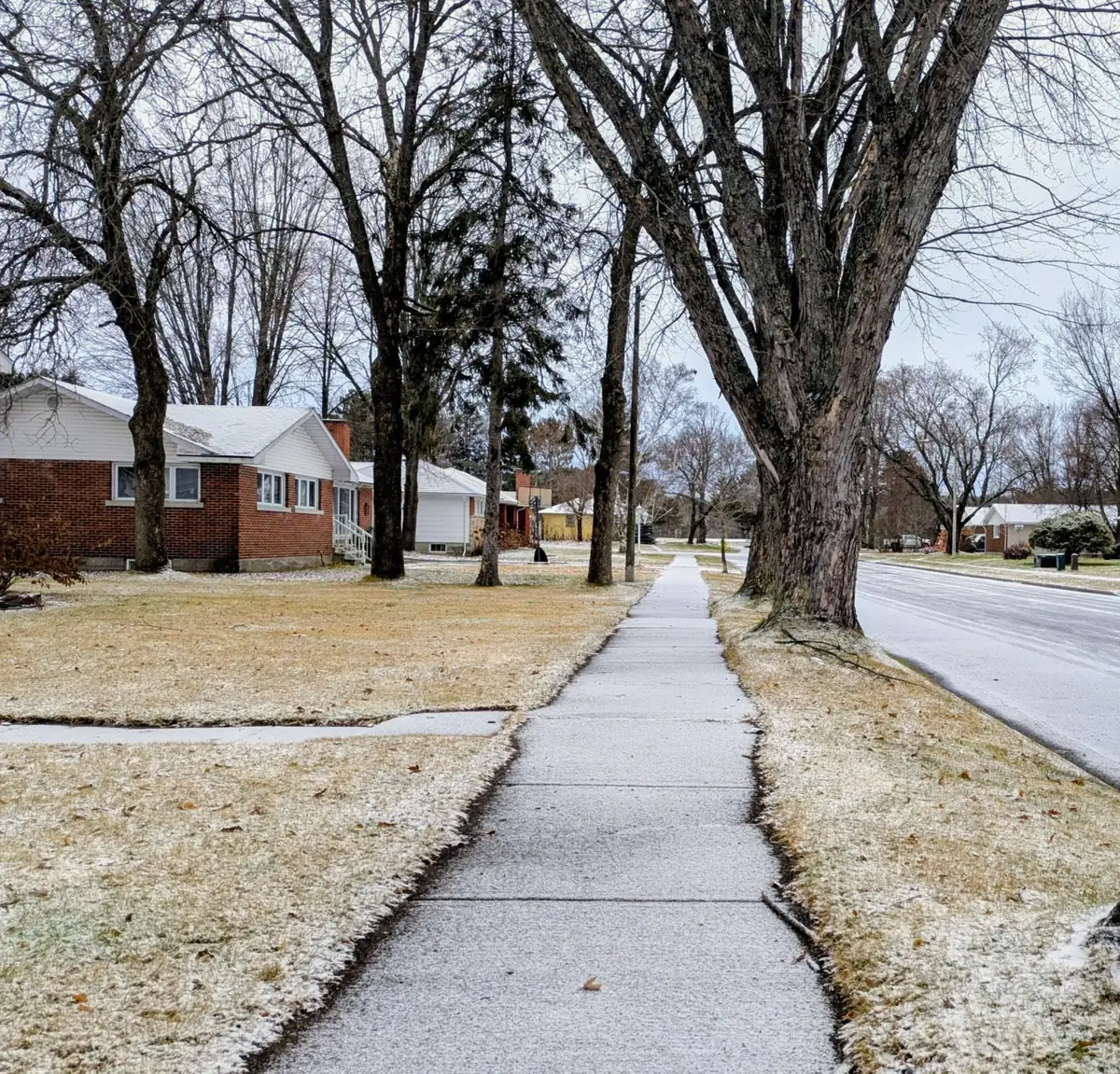
Try a forecast
Elgin's NOAA 1991–2020 normals put the median last spring freeze on April 26 and the median first fall freeze on October 18.
Cold-weather rules apply to this forecast.
- Below 40°F during the protection period: that is cold weather under ACI 306 (as summarized by STRUCTURE magazine), so the pour needs a cold-weather plan: blankets or tarps, warm concrete, and protection kept on.
- A night at or under 25°F: plastic concrete freezes at about 25°F, and frozen fresh concrete can lose more than half its potential strength (NRMCA CIP 27). It has to stay protected until it reaches 500 psi, about two days at 50°F.
- Cool but not cold (40–50°F): outside the cold-weather definition, but setting slows; a 20°F drop in concrete temperature roughly doubles setting time (NRMCA CIP 27), so finishing runs later into the day.
- Any freeze before the pour: snow, ice and frost come off the base and forms, and surfaces touching the concrete must be above freezing (NRMCA CIP 27). Concrete doesn't go onto a frozen base.
- Lows at 50°F or warmer: no cold-weather measures needed for temperature. Curing still matters: concrete left to dry out can lose as much as half its potential strength (NRMCA CIP 11).
A teaching tool, not a schedule: it reads temperature only. Rain, wind, sun, ground frost, slab thickness and the mix all change the call, which is made with the actual forecast the day before.
Local concrete for Elgin and the towns around it
Elgin sits on the Fox River, mostly in Kane County with a slice in Cook, and its housing runs from homes in the historic districts to new subdivisions; about one in five Elgin homes was built before 1940 (ACS 2024). Local concreters and concrete layers working here deal with both: old stoops and walks next to brick foundations, and newer driveways in HOA subdivisions with their own covenants.
We work in Elgin, South Elgin, St. Charles, Bartlett, Carpentersville, Hoffman Estates, Streamwood and Algonquin, and nearby Kane County. If you’re farther out, ask anyway, and if you’re too far for us to do the job well, we’ll say so rather than squeeze it in.
Concrete co near me? Send the details for an estimate
A name and phone number are enough to start. Photos and rough measurements get you a better first answer: email them to info@eliteconcreteelgin.com after you send the form.
Prefer to talk it through?
Concrete contractor questions from Elgin homeowners
Do I need a permit to pour a driveway or patio in Elgin?
Yes. The City’s quick guides say no work can begin before a permit is issued, with a plat of survey showing the new work, and a final inspection when it’s done. Work on the approach, public sidewalk or curb needs a separate engineering permit. See the driveway and patio pages for the construction minimums.
Are concrete contractors licensed in Elgin?
Elgin’s contractor requirements cover electrical, plumbing, roofing, mechanical, sewer and fire sprinkler work; the page sets no separate license for concrete contractors. Ask any concrete contractor for proof of insurance and a written estimate, and confirm who is pulling the permit.
Do you pour concrete steps and stoops?
Steps and stoops are rebuilt as part of concrete repair work. Elgin’s stairs guide asks for 42-inch-deep footings under stairs and landings and a pier inspection before they’re poured, so a new stoop is more than a slab with steps on it.
Can a sunken slab be raised instead of replaced?
Often, if it’s in one piece and the problem is the soil under it. Foam lifting or mudjacking costs less than replacement. Badly broken or scaled slabs are better replaced.
Can concrete be poured in an Elgin winter?
Yes, with cold-weather protection and the right forecast. Concrete must be kept from freezing until it reaches 500 psi, about two days at 50°F, and it can’t go onto frozen ground. Big exterior pours are easier to schedule between Elgin’s median last spring freeze (April 26) and first fall freeze (October 18).
What does a concrete contractor in Elgin need from me for an estimate?
Photos, rough measurements, the address or at least the town, and what you want done. A plat of survey helps for new driveways and patios. Use the form below or email info@eliteconcreteelgin.com.
Terms used on this page (5)
- Air-entrained concrete
- Concrete mixed with tiny, deliberate air bubbles that give freezing water room to expand. NRMCA calls for 6 to 7% air where deicers are used. Elgin’s driveway guide writes it as “air entrant” concrete.
- Plat of survey
- The surveyed drawing of your lot showing its lines and what’s built on it. Elgin’s driveway, patio and sidewalk quick guides ask for one, marked up with the new work.
- Approach (apron)
- The part of a driveway between the street and your property line, in the public right-of-way. In Elgin, work on the approach, the public sidewalk or the curb needs a separate engineering permit.
- Color hardener
- A dry colored powder broadcast onto fresh concrete and floated in before stamping, giving the surface its base color.
- Release agent
- Powder or liquid applied before stamping so the mats don’t stick. Colored release stays in the low spots and gives stamped work its second, antiqued tone.