Overlays for scaled, worn and tired slabs · Elgin, IL
Concrete Resurfacing Near Me: Overlays That Save a Sound Slab
An overlay is a thin, bonded new face on concrete that is still structurally fine underneath: flaking driveways, worn walks, dated patios and pool decks. It is not a fix for a slab that sinks, heaves or keeps cracking, and the first job is telling those apart.
The overlay sample board: tap a chip for thickness, use and upkeep
-
- Thickness
- Feather edge to 1/2 in. on one widely sold resurfacer’s data sheet (1/16 to 1/2 in.).
- Where it fits
- Scaled or worn driveways, walks and steps that should look like plain concrete again. Broomed for grip.
- Upkeep
- Treat it like the slab under it: hose off road salt, never use ammonium-based deicers, and reseal with a penetrating sealer.
- Source: Quikrete resurfacer data sheet
-
- Thickness
- A skim coat, troweled in one or two thin passes. Products vary and we have no single published figure to quote, so ask for the data sheet of the one being used.
- Where it fits
- A smooth, modern face on a sound patio, steps or an interior floor. It shows everything under it, so it is a finish, not a fix.
- Upkeep
- Needs a sealer to resist stains. Smooth surfaces get slick when wet or frosty unless grit goes into the sealer.
-
- Thickness
- Thin: spattered on with a hopper gun and flattened with a trowel. Thickness varies by product and pass.
- Where it fits
- Patios, walks and pool decks where grip matters. The mottled texture hides small blemishes in the slab.
- Upkeep
- Sealed like any overlay; the texture holds dirt, so it wants a wash before each reseal.
-
- Thickness
- 1/8 in. to 1/2 in. in one application on one manufacturer’s sheet, placed as deep as the stamp’s mortar joint.
- Where it fits
- Giving a sound, plain slab a stamped stone or brick look without tearing it out.
- Upkeep
- Reseal like stamped concrete. The overlay’s joints must be cut as full-depth and wide as the slab’s joints underneath.
- Source: Sika stampable overlay product page
Textures drawn to suggest each finish, not product photos. Every one of them needs a sound, bare slab underneath.
Is the slab sound enough for concrete overlay near me work?
Every overlay maker says the same thing in different words: Sika’s stampable overlay is “formulated for resurfacing structurally sound, non-moving concrete,” and Quikrete’s resurfacer is for “restoring the appearance of existing worn or scaled concrete surfaces.” Appearance, not structure. Below are two driveways. The left one is ugly but sound. The right one has five problems no overlay will survive; click where you see them.
-
An overlay copies the surface it sits on, including the step down at the joint. Lift the panel first, or replace it; resurfacing comes after the slab is back in plane.
-
Quikrete’s sheet: “Old cracks can reappear due to movement in the base concrete.” Sika says random cracks “may still transfer through the cured overlay.” A crack that opens every winter will open the overlay too.
-
“Apply only to bare concrete. Do not apply to painted or sealed surfaces” (Quikrete). Paint, sealer and curing film have to come off first, or the overlay bonds to the coating and lets go with it.
-
Both sheets say the joints must carry through: “Existing control joints should be maintained” (Quikrete); overlay joints “as full-depth and wide as the existing substrate joints” (Sika). Bridge a joint and the overlay cracks right over it, as this one did.
-
Tap it or drag a chain: a hollow sound means delamination. “Unsound concrete must be removed down to sound concrete” (Sika) before any overlay goes on.
How thick is a driveway overlay? Published thicknesses, to scale
Thinner than most people picture. The two products we cite here go on 1/16 to 1/2 inch (Quikrete’s resurfacer) and 1/8 to 1/2 inch (Sika’s stampable overlay) in one application. The drawing puts them beside a 4 inch slab edge and a stack of quarters, all to the same scale.
That thinness is why prep is the whole job. A skin that thin can only hold on by bonding to clean, open, bare concrete: Quikrete calls for a 2500 psi pressure wash and says that step “is essential to ensure a proper bond.” Old sealer, oil and the loose, scaled top all come off first.
It is also why an overlay adds no strength. It rides on the slab. Where the slab bends, cracks or drops, so does the overlay.
-
Elgin’s patio guide calls for patios at least 4 in. thick. Next to it, every overlay on this page is a skin: it adds a new face, not strength, and it rides on whatever the slab underneath does.
-
Quikrete’s Re-Cap data sheet: apply “from feather edge of 1/16 in to 1/2 in.” At the thin end that is about one quarter’s thickness.
-
Sika’s stampable overlay goes on 1/8 in. to a maximum of 1/2 in. in one application, as deep as the mortar joint of the stamp pattern.
-
A quarter is 0.069 in. thick. Seven stacked are about 1/2 in., the most either product sheet allows in one go.
Lighter bar: the most one application allows. Darker foot: the thinnest the sheet allows. Microtoppings and spray textures aren’t drawn because no verified product figure was found for them.
Driveway resurfacing: when it makes sense on a scaled drive
The usual complaint on a resurfacing candidate: the top skin has flaked off in thin patches, worst near the street and in the wheel tracks. That is scaling, and the local recipe for it is easy to see. City crews treat more than 380 lane miles with road salt and a brine of beet juice by-product, calcium chloride and salt; cars carry it up the apron. NOAA’s Elgin station averages 139 days a year with a low at or below 32°F. NRMCA’s scaling sheet asks for 6 to 7 percent entrained air where deicers are used and points to spots where plowed snow keeps the surface wet for long periods.
A driveway overlay makes sense when the slab is still in plane, the cracks are few and quiet, and the joints are where they should be. Then a polymer resurfacer, broomed for grip, gives the drive a uniform new face for far less than a tear-out. Plan around the weather: the resurfacer sheet we cite wants air and concrete between 50°F and 90°F, and 24 hours before cars go back on.
What a resurfaced drive still needs from you
The overlay is cement-based, so the same rules apply as for new concrete: hose off salty slush when you can, use salt sparingly, and never use ammonium nitrate or ammonium sulfate, which NRMCA says “destroy concrete surfaces.” A breathable penetrating sealer in late summer helps it shed water.
Concrete patio resurfacing: refreshing a sound patio
Patios are often better overlay candidates than driveways: no cars, less salt, and the complaint is usually looks rather than damage. A plain gray slab from the 1990s can get a smooth microtopping, a grippy spray knock-down texture, or a stampable overlay that turns it into slate or brick without breaking it out.
The same test applies. A patio that has settled toward the house, or tipped so water stands against the foundation, needs its slope fixed before it gets a new face. Elgin’s patio guide wants new patios at least 4 inches thick on a recommended 4 inch gravel base; an old patio poured thinner, or straight on dirt, often fails the soundness test, and then a new concrete patio is the honest answer.
Pool decks, steps and worn decorative finishes
Overlays are common on pool decks, where a textured finish is cooler and less slippery underfoot. Steps can be resurfaced if the treads are sound; crumbling or tipping stoops are a concrete step repair or rebuild, because Elgin’s stair guide wants new stairs on 42 inch footings. A faded stamped patio may only need cleaning and resealing; a worn one can get a stampable overlay. Patterns and sealing are covered on the stamped and decorative concrete page.
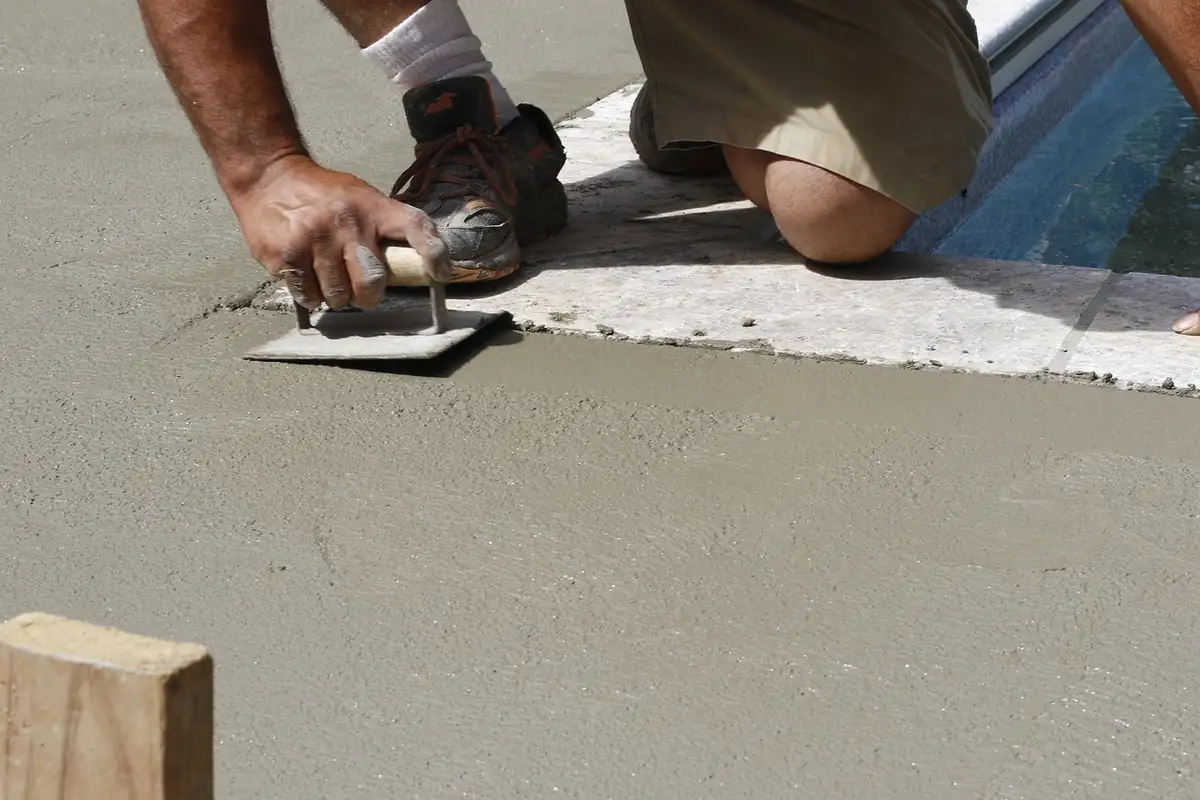
Overlay types compared: resurfacer, microtopping, spray texture or stampable
The sample board at the top of the page holds the four families side by side. The choice usually comes down to the job the surface does.
| Overlay | Best on | Grip | Watch for |
|---|---|---|---|
| Polymer resurfacer, broomed | Driveways, walks, steps | Good (broom finish) | Must keep joints open; bare concrete only |
| Microtopping | Patios, interior floors | Low unless grit is added | Shows every flaw under it |
| Spray knock-down | Pool decks, patios, walks | Good | Texture holds dirt; reseal on a wash |
| Stampable overlay | Patios needing a new look | Depends on pattern and sealer | Placed as deep as the stamp’s joint; joints full-depth |
Sources: Quikrete Re-Cap resurfacer data sheet (revised January 2023); SikaCem-172 stampable overlay. Other products differ; ask for the data sheet of the one quoted.
Concrete resurfacing cost and how long it lasts
We don’t have a trustworthy published figure for resurfacing in Elgin. The one lead-service page that combines repair and resurfacing here lists an average above its own typical range, so we don’t quote it. What we can tell you is where the money goes.
- Prep: pressure washing, grinding off sealer or paint, cutting out delaminated spots. Often the biggest line.
- Repairs first: patching spalls, routing cracks, lifting a sunken panel.
- Product and build: a broomed resurfacer is simpler than a multi-coat stampable overlay with color and sealer.
- Joints: cutting the overlay’s joints back in over the old ones.
- Size and access: small jobs carry the same setup as big ones.
How long it lasts depends on the slab under it more than anything we put on top. Resurfacing a sound slab and keeping salt off it is money well spent. Resurfacing a moving one is the most expensive way to end up replacing it.
Send photos of the slab for a resurfacing opinion
Photos settle most resurfacing questions before anyone visits: one of the whole slab, close-ups of the worst areas, any cracks with a coin for scale, and the joints. Tell us if it has ever been sealed, painted or patched.
Concrete resurfacing questions from Elgin homeowners
How long does concrete resurfacing last?
No honest number fits every slab. On a sound, well-prepared slab with its joints kept open and salt hosed off, an overlay can last many years; on a slab that moves, cracks can come back in the first winter. Prep and the slab underneath decide it more than the product does.
When can I drive on a resurfaced driveway?
It depends on the product and the weather. One widely sold resurfacer’s sheet says to wait 8 hours for foot traffic and 24 hours for vehicles, and to apply it only when air and concrete are between 50°F and 90°F. Ask for the timing of the product being used on your job.
Can resurfacing fix cracks?
It can hide fine, dead cracks for a while. It cannot stop a crack that moves, and both manufacturer sheets we cite warn that cracks can come back through the overlay. Moving cracks and broken slabs are a crack repair or replacement question first.
Can a sunken slab be resurfaced?
Not until it is level again. An overlay follows the slab. If the slab is in one piece, lifting the sunken slab first and resurfacing after is often still cheaper than replacing it.
Is resurfacing cheaper than replacing the slab?
Usually, because there is no tear-out, haul-away, base or new concrete. But if the slab fails the soundness test, the overlay is money spent twice: once on the overlay and again on the replacement it only delayed.
Can I resurface concrete myself?
Bagged resurfacers are sold for homeowners, and their data sheets are clear about what matters: a 2500 psi pressure wash, bare concrete, joints kept open, and the 50°F to 90°F window. The hard part is working a whole driveway before the material stiffens; that is where a crew earns its price.
Terms used on this page (4)
- Microtopping
- A very thin polymer-modified cement coat troweled or squeegeed over a sound slab in one or two passes, for a smooth or lightly broomed new face.
- Spray knock-down texture
- Overlay material spattered on with a hopper gun and flattened with a trowel once it stiffens, leaving a mottled, grippy surface often used on pool decks and walks.
- Stampable overlay
- A thicker polymer-modified overlay placed over an existing slab and imprinted with stamp mats. One manufacturer’s sheet says to place it as deep as the joint you plan to imprint.
- Delamination
- A top layer that has let go of the concrete below it. Tapping or dragging a chain over it gives a hollow sound instead of a solid ring.